
Creative Crop Rotation
Greeting from Italy! Inside: an update on Umbra and The School of Memory and how slow-motion multitasking has become a new way of developing work

This is the eighth installment of my newsletter about theater, process and practice. If you’re new: Welcome! You can find previous installments here: We All Need a Prehistory, A Heap Of Broken Images, The Art of Transitions, Taroturgy, Datamoshing, Not light, not darkness, but something in between and Plays without Words.
Hello friends,
I’m writing from the heart of the Dolomites, from the Pale Mountains of the Italian Tyrol—peaks that, were they a rock band, would provide a stunning opener for a headliner called The Alps.
More on what I’m doing here in a moment…
But first I want to share a quick update on two of the big projects I’ve been developing over the last year. They mark a major shift in my practice and, since they are still in development, I want to let you know how they are growing.

Umbra
In March, I directed a staged workshop production of Elliot Menard’s opera Umbra.
New Classic LA called it “a tightly produced and beautifully performed work.”
Highways Performance Space, our venue, posted:
“Umbra was something rare: an opera that felt both mythic and urgent, personal and otherworldly. What we saw wasn’t just a promising work-in-progress. It was the birth of something electric. The music lingered like smoke. The staging cut deep. This is opera stripped of ornament, driven by instinct and imagination. Keep your eyes on Umbra—this piece is only just beginning its journey, and we’re honored to have been part of its first steps.”
A friend of mine told me she cried all the way home while driving on the 405.
This warm response has energized Elliot and I to dive deeper into the work’s next phase and to tackle some dramaturgical problems that became apparent when we put the opera in front of an audience for the first time.
We discovered that the role of the ensemble needs to be clarified and that the mythic framework felt less resonant than Elliot’s personal story of loss.
We’re also thinking about the kind of relationship we want the audience to have with the sung Latin text. We chose not to provide English supertitles (a risky but very intentional choice) and well… we learned that we need to rethink that choice.
(This is a question I’m always asking myself, no matter the project: what’s the right balance between mystery and transparency?)
Now Elliot and I are looking for presenters, funders, and producers who can partner with us to have an official premiere for Umbra in 2026 or 2027.
The School of Memory
This excavation of family and political history (I’ve written about it here, here and here) has evolved through several stages over the past twelve months. Here are four glimpses that chart its growth:
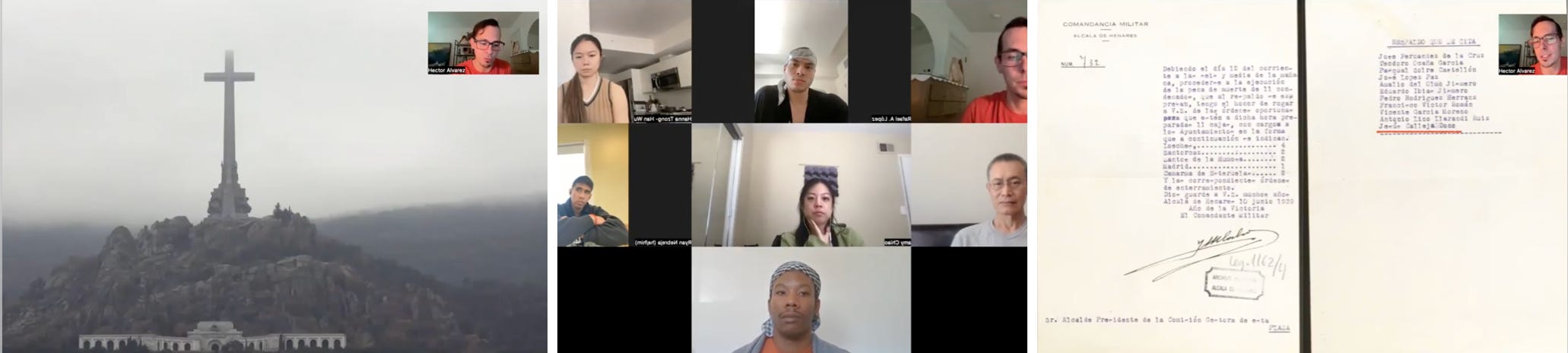
June 16, 2024 | Draft Zero: First public sharing via Zoom with an audience of six experimental artists. Guiding question: How do the dead come back?

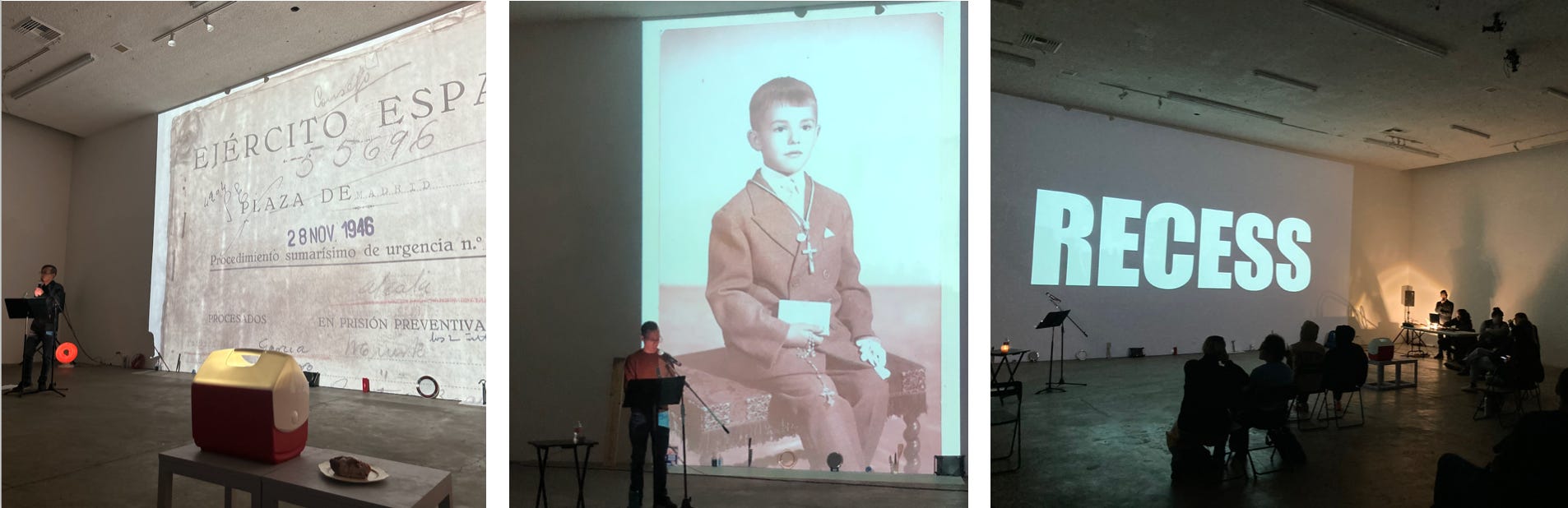
March 12, 2025 | Human Resources, Los Angeles - First ‘Work-in-Progress’ Presentation: After workshopping material with Emory students, I presented a first draft mixing academic discourse, storytelling, and performance art. I invited artist Juniper Jones to create a soundscape for the piece, which they created live on stage with their computer and turntable. New guiding question: How do you represent a violent death without committing more violence in the act of representation? Seventy people attended. Clear takeaway: cut twenty minutes.

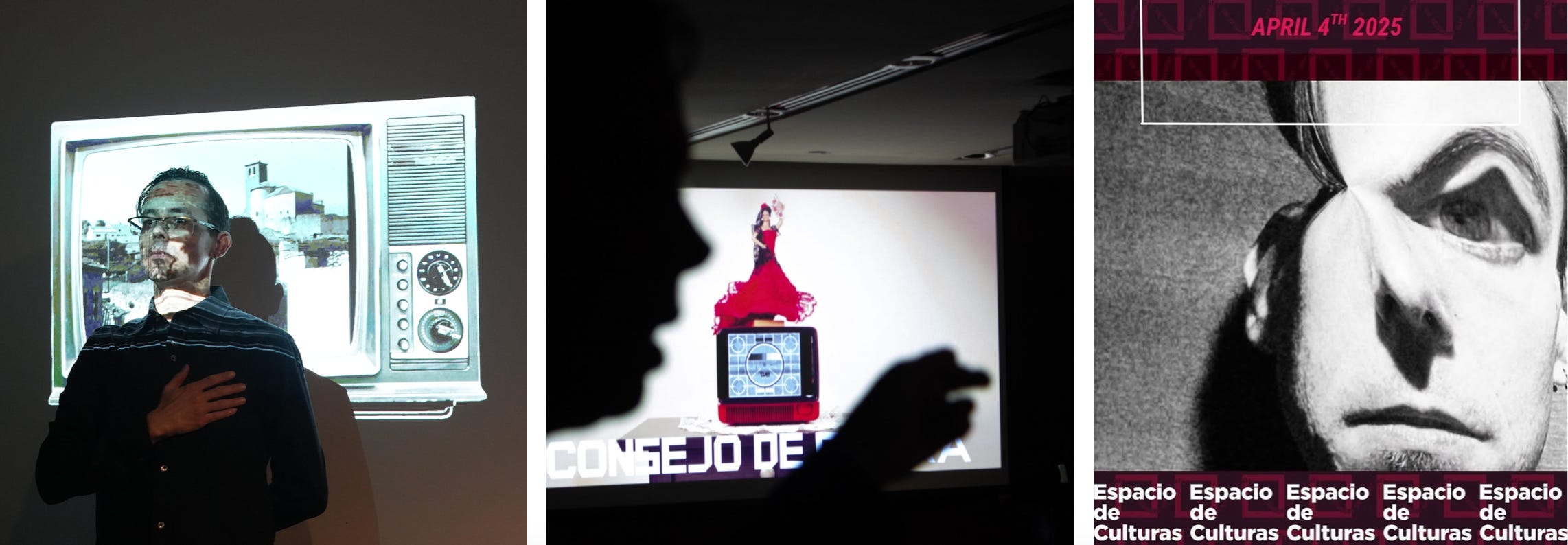
April 4, 2025 | NYU Espacio de Culturas: Parallel development with Chilean technology artist Attilio Rigotti began in September 2024 through bi-weekly conversations, exploring how technology recovers and erases historical memory. After a four-day Brooklyn workshop in December, we continued working remotely, and in April of this year we presented 40 minutes of material at NYU, followed by a panel discussion with Spanish artist Francesc Torres. Well-received, but I left New York with the certainty we hadn’t cracked the form yet.

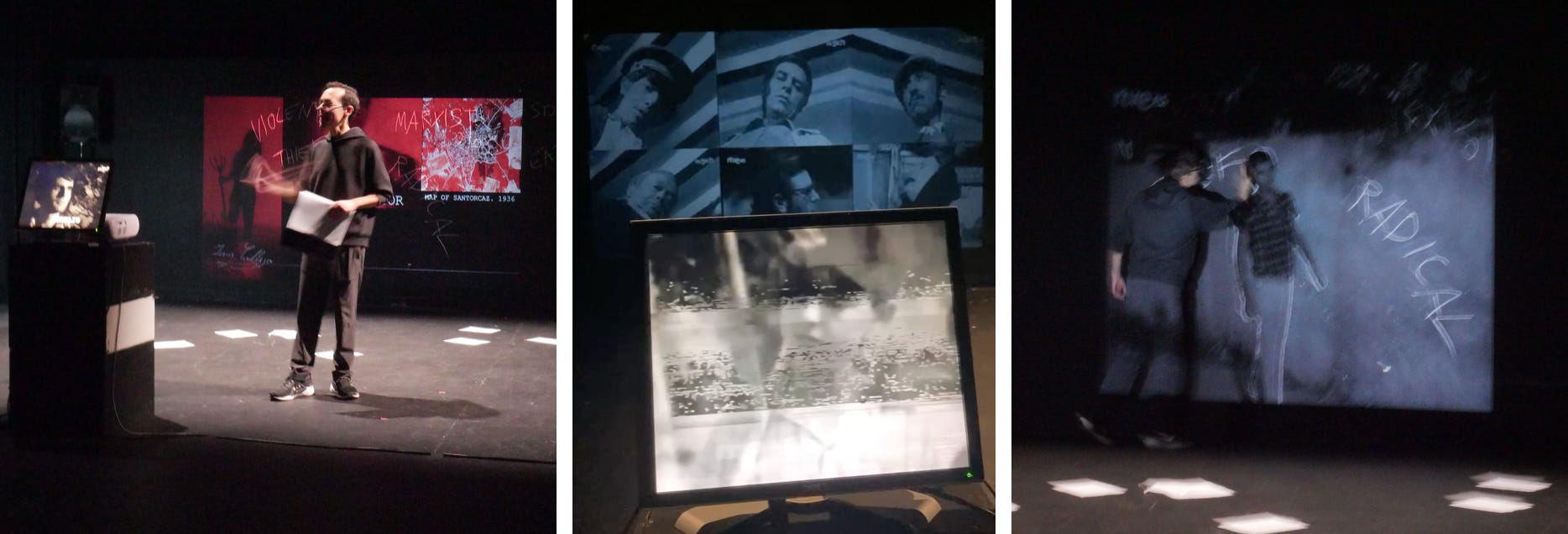
June 6-10, 2025 | New York Theater Workshop Summer Residency: Five-day intensive with Attilio at Adelphi University, merging LA material with NY visual language. Breakthrough moment: “filming” a TV episode in front of the audience by mixing live performance with archival footage.
Both projects share a common thread: extended development time that would have been impossible without institutional partners who understand that some works don’t emerge from rushed production cycles, but from slow experimentation.
We’re in of the toughest environments (culturally and financially) for the creation of new work.
Given this reality, I’m doubly grateful to New York Theater Workshop, Espacio de Culturas/NYU, What Will The Neighbors Say?, Human Resources, Highways Performance Space, the J. M. Kaplan Fund, the Morris A. Hazan and Beverly Blank Perry Foundations, Stupleme, Humanity in Action, Emory University, and to the private donors and all the audience members who provided feedback.
Without this support none of this could happen.
There’s a peculiar thing that happens when you shift from directing other people’s plays to creating original work.
The clock changes.
For years, I lived by the ruthless timeline of the American theater: a few months of pre-production, two to six weeks of rehearsal, the deadline of opening night.
But original creations like Umbra or The School of Memory? Well, in this environment… they take as long as they take. They teach you patience. They ask you to embrace a different mode of production.
Enter “slow-motion multitasking.”
Economist Tim Harford coined this term to describe a pattern he observed in the work of highly creative people.
In a great TED talk, Harford cites Charles Darwin as an example.
When he returned from the Beagle voyage, Darwin didn’t focus on one thing. He was simultaneously fascinated by zoology, geology, psychology, botany, even economics. In 1837, he began studying two seemingly unrelated subjects: earthworms and “the transmutation of species.” When his son William was born, Darwin immediately started documenting infant development. He also spent eight years becoming the world’s leading expert on barnacles. Barnacles!
Here’s the ‘slow-motion’ part: Darwin published The Origin of Species twenty years after conceiving its basic elements. His book on human development took thirty-seven years to finish.
But this wasn’t procrastination. Darwin was practicing intellectual crop rotation—moving between projects as inspiration struck and opportunity allowed, letting ideas from one field to cross-pollinate with another. The earthworm research informed his understanding of evolution. Watching his son crawl led to breakthrough insights about human development.
I’m no Charles Darwin, but I’m learning the value of switching back and forth between projects, I’m learning to appreciate the creative marathon over the sprint.
To end, I leave you with the equivalent of my foray into the world of barnacles.
As I mentioned at the beginning I’m in the mountains of northern Italy. I’m here at the invitation of my friend the choreographer Norbert de la Cruz, who’s creating a new ballet with seven extraordinary dancers at the Trentino Music Festival. Norbert has asked me to dramaturg the piece—our third collaboration—and to lead the dancers through devising exercises that generate choreographic material.
I love how dance dramaturgy stretches my directorial practice, the same way working in opera or film feeds back into my theater work.
And working in this stunning natural setting reminds me of the relationship between majesty and slowness.
These mountains (I just learned) originated in the Mesozoic period as coral reefs in a tropical sea. Those sediments were then uplifted by colliding tectonic plates.
Like Venus, ancient goddess of beauty, the Dolomites were born from the sea… in a slow motion gesture that took 250 million years.

Thank you for reading and for being part of this creative journey. I hope your summer is going well!
With love,
Héctor